Industries / Rail
A living operational picture of the railway.
Rail work depends on people, plant, access, assets and conditions lining up safely at the same moment. Omniscient connects the systems that describe each of them into one live, evidence-backed picture for planners, controllers and teams on the ground.
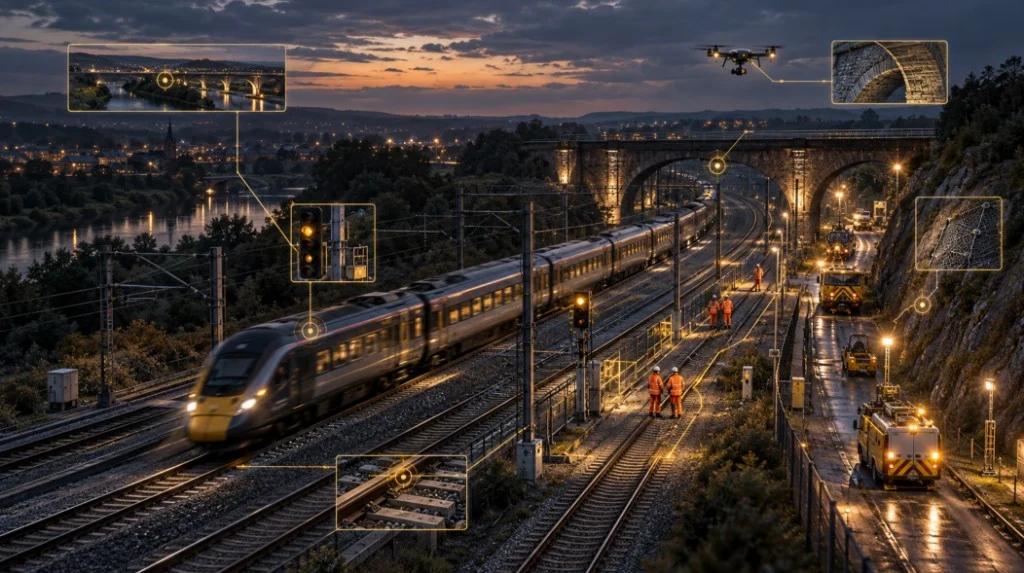
The operational model
Everything that decides whether work is safe, connected.
Each of these is usually managed in a separate system. Omniscient relates them so the questions that matter — who, where, under what protection, on which asset — can be answered at once.
01
People
Who is on the railway, what they are qualified to do and whether they are fit to do it.
Workers
Live presence of individuals and work groups, linked to their planned tasks.
Competencies
Qualifications and authorisations checked against the work being undertaken.
Fatigue
Shift patterns and hours considered before people are committed to work.
02
Work and access
Where work is happening, under which protection arrangements and with which equipment.
Sites
Access points, compounds and locations described in a shared geospatial model.
Work zones
Planned and live boundaries of work, kept consistent with what is happening on site.
Possessions
Possession limits and timings connected to the work and people inside them.
Isolations
Electrical isolation status associated with the zones and tasks that depend on it.
Vehicles
On-track and road–rail plant located relative to people and work zones.
03
Assets and condition
What state the infrastructure is in and how that should shape upcoming work.
Infrastructure
Track, structures, earthworks and signalling assets as connected records.
Inspection
Findings from people, sensors and drones linked to the assets they describe.
Predictive maintenance
Emerging condition trends surfaced early enough to plan work and access.
Perceive · Understand · Act
From fragmented records to accountable decisions.
- 01
Perceive
Connect rostering, competence, access planning, plant telematics, inspection and asset systems into one geospatial model of the railway.
- 02
Understand
Relate people, work, zones, possessions and assets so conflicts, missing authorisations and emerging condition risks become visible early.
- 03
Act
Present evidence-backed recommendations to the people accountable for them — planners, controllers and site leads — and record what was decided.
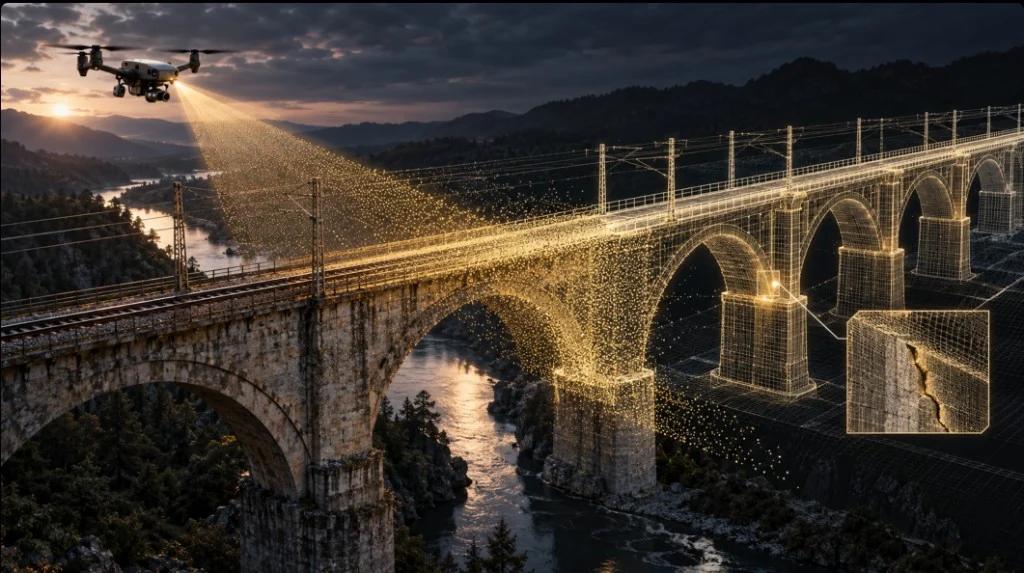
Autonomous inspection
From drone flight to digital twin.
01
Capture
Planned, repeatable drone flights collect consistent imagery of bridges, viaducts, cuttings and structures — reducing time spent at height or near the line.
02
Reconstruct
Imagery becomes a measurable three-dimensional digital twin aligned to known asset locations.
03
Compare
Change detection highlights cracking, movement or deterioration against previous inspections.
04
Prioritise
Findings are placed in context with risk, planned work and track access so maintenance can be scheduled sensibly.
Safety principles
Designed to strengthen safety-critical judgement, not replace it.
Supports established safety processes
Omniscient is designed to give existing safety management processes better context. It does not replace the rules, roles or authorities that govern work on the railway.
Evidence behind every alert
Conflicts and gaps are presented with the records that produced them, so people can verify a concern quickly rather than trusting a black box.
Conservative when data is missing
Absent or stale information is shown as uncertainty, never silently treated as safe.
Building a safer, more resilient railway?
We welcome conversations with infrastructure managers, contractors and rail technology teams about scoped operational pilots.
Discuss a rail pilot